Books from other publishers

As well as publishing its own books, the LRRSA also sells a small range of carefully selected books from other publishers in Australia and overseas.

Details of books currently available are described below.

Prices

All prices are in Australian dollars and include GST.

Overseas purchasers note: the prices include Australian Goods & Services Tax (GST) which amounts to one-eleventh of the quoted price. We will deduct this on all export sales.

At current exchange rates (28 September 2007) one Australian dollar is worth 87 US cents, 42 UK pence, or 61 Euro cents, but note that exchange rates vary to some extent every day.

The easiest way to pay for overeas purchases is to quote your credit card number. The credit card company will then do the currency conversion, and the amount will appear on your credit card statement in your own currency.

Click here to go to the LRRSA Online shop


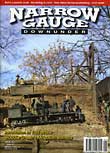
Narrow Gauge Downunder - No.30

July 2008


Published by Gavin & Louise Hince

60 pages, A4 size, colour printed throughout.

This very well produced magazine is primarily directed to railway modellers but includes much prototype information.

This issue includes another article by David Fletcher on Baldwin locomotive painting styles, with special reference to 0-4-0STs (eg Sandfly), South Australian Railways X class 2-6-0 locomotives, and the Mount Lyell Mining and Railway Company's 0-6-0T locos. It includes beautifully detailed colour reproductions of the liveries these locomotives were painted in when they left the Baldwin factory.

Other articles relating to prototypes include A class Climax locomotives in Australia (including some excellent photographs), and how to find timber tramway relics east of Powelltown.

$A12.00 plus postage
[price to LRRSA members $10.80 plus postage]

(Weight 240 gm)


Rails through the Bush

Timber and firewood tramways and railway contractors of Western Australia

Second Edition
By Adrian Gunzburg & Jeff Austin
Published 2008 by Rail Heritage WA

304 pages, 231 x 295mm landscape format, hard cover with dust jacket, many photographs (now including 28 in colour), maps and scale drawings of many locomotives at 1:64 scale.

This is the definitive work on the steam locomotives of the Western Australian logging and firewood railways, and Western Australian railway contractors. It includes a brief historical introduction to each company. Western Australian logging tramways were very different to those in the east. They were much bigger operations, and had a more railway-like character. They had a wonderful collection of locomotives, mostly from American and British suppliers, and most were bought new. Unlike in the east, few were geared, and few were "home-made".

This is a completely revised edition of the book first published by the LRRSA in 1997 which sold out within eighteen months.The reproduction of the black and white photos is now greatly improved by the use of the duo-tone process, and many are reproduced much larger.

$A99.00 plus postage
[price to LRRSA members $89.10 plus postage]

(Weight 2,100 gm)


Narrow Gauge Downunder - No.29

April 2008


Published by Gavin & Louise Hince

60 pages, A4 size, colour printed throughout.

This very well produced magazine is primarily directed to railway modellers but includes much prototype information.

This issue includes a very well researched article by David Fletcher on Baldwin locomotive painting styles, with special reference to Victorian Railways NA class locomotive No.1, and the Powelltown tramway's Little Yarra locomotive. It includes beautifully detailed colour reproductions of the liveries these locomotives were painted in when they left the Baldwin factory. By way of comparison, the original livery of the English Lynton & Barnstaple Railway's Baldwin 2-4-2T loco Lyn is also described and illustrated in colour.

Other articles relating to prototypes include Queensland cane mills first generation mainline diesels, and A class Climax locomotives in Australia (which includes some excellent photographs).

$A12.00 plus postage
[price to LRRSA members $10.80 plus postage]

(Weight 240 gm)


Narrow Gauge through the Bush

Ontario's Toronto Grey & Bruce and Toronto & Nipissing Railway

By Rod Clarke
Published 2008 by the author

392 pages, 275 x 300 mm, landscape format, hard cover, 300 illustrations, including photographs, maps, plans, and drawings. Eight pages are in colour.

This is a comprehensive history of the promotion, building and operation of two passenger carrying, 3ft 6in gauge railways in Ontario, Canada. It covers the period 1866 to 1883. The Toronto & Nipissing Railway was promoted as the first public narrow-gauge railway opened in North America. It opened in the Summer of 1871, before the Denver & Rio Grande.

The locomotives include Avonside 0-6-6-0 Double-Fairlies, 4-6-0's and 4-4-0's, Baldwin 2-6-0's and 2-8-0's; and Canadian Engine and Machinery Co. 4-4-0's. The scale drawings  are magnificent works of art.

The book covers a very interesting time in Canadian railway history, when it seemed they might have been going down the Australian path with broad gauge (5 ft 6 in) standard gauge and 3 ft 6 in gauge. Fortunately they thought better of it, and the Ontario 3 ft 6 in gauge lines were all converted to standard gauge by 1883.

It was also a time when they were seeking a more economical method of building railways than the very expensive traditional English way. It was a transitional phase when the English influence on Canadian railways was giving way to other methods – hence locomotives built by Avonside worked alongside Baldwins, and locally built products.

There was also an Australian involvement: Abraham Fitzgibbon, Chief Engineer of the Queensland Railways in the late 1860s, came to Toronto to help with the promotion after he retired.

The author, Rod Clarke, has been researching for 22 years, and has been working on the scale drawings for eight years. Much of his information has come from sources in England and Norway, and he has had to learn sufficient Norwegian to translate a lot of original material.

Why Norwegian? The first public "mainline" 3 ft 6 in gauge railway in the world was opened in Norway in 1862, thanks to the efforts of the Norwegian Civil Engineer Carl Abraham Pihl. Carl Pihl had a lot of influence on the subsequent development of 3 ft 6 in gauge in Queensland and Ontario, and other places.

More information on this book can be found at this website:

http://www.narrowgaugethroughthebush.com/

We have a limited number of copies of this book on the way from Canada. If you are interested in buying a copy, please let us know, and we will advise you when stocks arrive. There is no need to pay at this stage.

The print run is limited to 1,500, and on that basis it will probably sell out quickly, as it has had excellent reviews in North America and the United Kingdom.

$A127.00 plus postage
[price to LRRSA members $114.30 plus postage]

(Weight 2,750 gm)


The Bellerive to Sorell Railway - Revisited

Second Edition
By John Houghton et al
Published 2007 by Bellerive Historical Society Inc.

204 pages, 255 x 187mm, hard cover with dust jacket, 132 photographs, 26 maps and diagrams, many reproductions of historic documents.

The Bellerive to Sorell railway was a 3ft 6in gauge line operated by the Tasmanian Government Railways.

It was an endearingly eccentric operation which proabably should never have been built, at least on the route chosen.

Separated from the rest of the TGR system by the Derwent River, it was opened in 1892, and closed in 1926. In its 23.7km it included several interesting features: a terminal station on the end of a pier; a 164m long stone-lined tunnel; at 256m long stone causeway; a 582m long timber viaduct; and the 400m long Shark Point cutting.

The railway used ex-Tasmanian Main Line Railway Company rolling stock, which had been banished from the main system due to its centre-buffer link-and-pin couplings, and continuous chain-brake system. The four-wheeled carriages were not noted for their comfort: “coming in today I almost had my arse pinched off” wrote one irate passenger.

The book includes reproductions of many original documents, extensive details of the route, details of ferry connections across the Derwent, and proposals for extensions, branches, and connections to the main system, either by bridging the Derwent, or by train ferry. It also includes extensive details of what is left, (which is considerable), and how to find those remains which are accessible to the public.

The book is very well presented, and a high-quality production. It paints an excellent picture of how the railway operated in the community. However, some of the diagrams need to be treated with caution, e.g. the photographs of the station at Cambridge show a building much bigger than that in the diagram. Also, the book is a little vague on some details railway enthusiast would like to know, for example the precise identity of the third locomotive, a Hunslet 4-4-0, but the first two, Dübs & Co. 4-4-2Ts, are very well covered.

There is an index of personal names, but no general index, which makes finding specific details (like the tunnel length), somewhat difficult.

In summary, this is a delightful book about a fascinating railway. The first edition, which was considerably smaller, sold out almost as soon as it was printed.

$A45.00 plus postage
[price to LRRSA members $40.50 plus postage]

(Weight 950 gm)


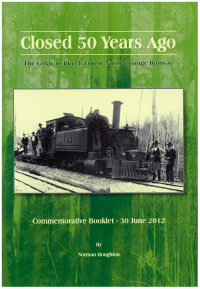
Beech Forest

Capital on the Ridge

By Norm Houghton
Published 2007 by the author

112 pages, A4 size card cover, many photographs and illustrations.

A complete history of the town of Beech Forest and surrounding district. It includes the important role the narrow-gauge railway, timber tramways and the timber industry played in the town's industry.

The book is digitally printed, and the photographs are well reproduced within the limitations of the printing process.

$A29.95 plus postage
[price to LRRSA members $26.96 plus postage]

(Weight 450 gm)


Focus on ... Victoria's Narrow Gauge Gembrook Line - Part Three

A Pictorial Tribute to the late Edward A. Downs, Railway Historian

Compiled by John Thompson
Published 2007 by Puffing Billy Preservation Society

42 pages A4 size landscape format, soft cover, 50 photographs most published for the first time.

A follow-up to Focus on ... Victoria's Narrow Gauge Gembrook Line Part Two and produced to the same high standard.

It starts with a continuation of photos of the Saturday morning train on 24 January 1948, hauled by 13A, including views at Gembrook, Cockatoo, crossing bridge No.8, taking water at the Water Tanks, crossing bridge No.5, crossing another train at Belgrave, en route to Upwey, and crossing bridge No.1.

Then follow a series of pictures taken in March 1954 showing an assortment of rolling stock at Upper Ferntree Gully, the locos, loco shed, and loco facilities at Upper Ferntree Gully, and the goods transfer facilities.

Then follows a series of pictures taken in January 1955 including Belgrave, Emerald, Fielder, Gembrook, Selby, Menzies Creek, Clematis, Nobelius Siding, Nobelius, Lakeside, and Wright stations.

As usual in this series the photographs are printed as duotones. They are sharp, well exposed, the composition is excellent, the detail is wonderful, and the captions are well written and informative.

$A35.95 plus postage
[price to LRRSA members $32.35 plus postage]

(Weight 280 gm)


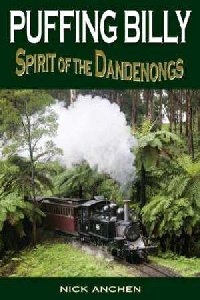
Puffing Billy

Spirit of the Dandenongs

By Nick Anchen. published by Sierra Publishing

64 pages, 240 x 170 mm, card cover, 216 photographs, almost all in colour, but some very small.

A general introduction to the Upper Ferntree Gully - Gembrook railway. Includes a potted history of the railway, a description of the line, and what is to be seen on the trip, a day in the life of an engine crew, flora and fauna of the Dandenong Ranges, details of the locomotives and rolling stock, including the three non-steam locomotives, and the goods vehicles, workshop operations, and special trains.

$A17.95 plus postage.
[price to LRRSA members $16.16 plus postage]

(Weight 240 gm)


Launceston Municipal Transport
1911-1955

By Ian G Cooper
Published 2006 by Transit Australia Publishing

170 pages, A4 size, soft cover, 145 photographs (18 in colour), 5 maps, illustrations of tickets in colour, fleet lists, bibliography.

Launceston was late amongst Australian provincial cities in developing an electric tramway system, and they missed out on the steam and horse varieties. But once they started, they developed their 3 ft 6 in gauge system with great enthusiasm, ending up with a system that was large for a city of its size. It seems to have been appreciated too, for its traffic figures were very high compared to other Australian tramway systems. At its peak in 1946 there were eight routes and 29 tramcars. Several of the routes were in very hilly areas and provided challenges both in construction and operation, with grades of 1 in 10.

This is a thoroughly researched history of the system, and very well illustrated. It includes full details of the trolley bus system that replaced the tramways, as well as the petrol and diesel buses operated by Launceston Municipal Tramways. The book is very well illustrated, and the quality of the photographic reproduction is good. The book ends in 1955 when the installation of the trolley-bus system was practically complete, - three years after the last tram ran. It is very interesting reading of all the problems after the second-world war due to the shortages of practically everything needed to run a transport system. Amongst the colour pictures are six postcards from around the 1912 era. Perhaps for me the most memorable photographs were of the three very peculiar steam buses which were tried in 1904-05. They win the award for wierdness, I think.

$A55.00 plus postage
[price to LRRSA members $49.50 plus postage]

(Weight 900 gm)


Homes in the Hills

Historic glimpses of Barongarook, Gellibrand, Banool and Carlisle River

By Norman Houghton, published by the author

48 pages, A4 size, card cover, 40 photpgraphs, 8 maps and diagrams.

This digitally printed booklet is a brief history of the areas and communities served by the northern section of the Colac to Beech Forest narrow gauge railway. Contains much information on the railway and timber tramways, and includes many very interesting photographs, which are well reproduced within the limitations of the printing process. The photographs are not limited to railways and tramways, but include community buildings. There is much information on the rail trail.

Some of the maps are from the LRRSA book The Beechy, but are printed in one colour only.

$A12.50 plus postage.
[price to LRRSA members $11.25 plus postage]

(Weight 170 gm)


Focus on ... Victoria's Narrow Gauge Beech Forest Line - Part Two

A Pictorial Tribute to the late Edward A. Downs, Railway Historian

Compiled by John Thompson
Published 2006 by Puffing Billy Preservation Society

42 pages A4 size landscape format, soft cover, 62 photographs most published for the first time.

A follow-up to Focus on ... Victoria's Narrow Gauge Beech Forest Line Part One and produced to the same high standard.

The first picture is a delightful view of loco 11A on a short train at Ferguson headed for Colac. The train has an NQ wagon loaded with a four-wheel dray, the NT van, and an NC van. The next six pictures show the gradually lengthening train as it makes its way to Colac.

There follows a series of photos around Colac including detailed close-ups of locomotives 14A and 5A, NM cattle vans, NQ trucks, the transfer shed and the coal stage.

Next is a trip behind G41 in March 1954. Included in this series is a wonderful view of Coram station in all its glory. There are three excellent views of the horse-hauled 2 ft 7 in gauge Kawarren lime tramway in operation.

There are good views of Gellibrand and Dinmont stations, and a number of views around Beech Forest station.

The quality of the photographs is excellent, both technically and pictorially. They bring the nature of this steeply-graded sharply curved railway to life, as the trains make their way through the dense forest.

For a railway modeller this book is essential, as it shows details rarely seen in photographs. As with the other books in this series, the captions are short but informative and authoritative.

$A35.95 plus postage
[price to LRRSA members $32.35 plus postage]

(Weight 280 gm)


Focus on ... Victoria's Narrow Gauge Gembrook Line - Part Two

A Pictorial Tribute to the late Edward A. Downs, Railway Historian

Compiled by John Thompson
Published 2006 by Puffing Billy Preservation Society

46 pages A4 size landscape format, soft cover, 46 photographs most published for the first time.

A follow-up to Focus on ... Victoria's Narrow Gauge Gembrook Line Part One and produced to the same high standard. This one includes views around the loco depot at Upper Ferntree Gully in 1948, and rolling stock at Upper Ferntree Gully including two different NQR trucks adapted for livestock traffic.

Then there is a series of photos of the Saturday morning train on 24 January 1948, hauled by 13A, including views from the train, at the water tanks, passengers riding on the footboards, shunting at Cockatoo, arrival at Gembrook station, watering the loco at Gembrook, timber tramway trucks at Gembrook, and crossing the afternoon train at Belgrave hauled by 3A.

This is followed by views on another trip on Saturday 13 March 1948, showing many passengers clinging to the outside of the train, arrival at Emerald, and views around Gembrook station.

The photographs are printed as duotones. They are sharp, well exposed, the composition is excellent, the detail is wonderful, and the captions are well written and informative. The pictures were taken at a time when few people owned cars, petrol was rationed, tyres were hard to get, and Puffing Billy was used as an escape from the city for the residents of Melbourne.

$A35.95 plus postage
[price to LRRSA members $32.35 plus postage]

(Weight 280 gm)


Focus on ... Victoria's Narrow Gauge Beech Forest Line - Part One

A Pictorial Tribute to the late Edward A. Downs, Railway Historian

Compiled by John Thompson
Published 2004 by Puffing Billy Preservation Society

48 pages A4 size landscape format, soft cover, about 50 photographs most published for the first time.

Includes a number of views of Beyer Garratt loco G41 on a mixed train between Gellibrand and Crowes in the 1930s, when it still had its original flanged chimney; several views around Gellibrand and Beech Forest stations; good close-up pictures of passenger and goods rolling stock; taking water at Kincaid Water; and many views around Crowes. Many of these pictures give a very good impression of the winding course of the railway.

Another series of pictures covers a trip on the line in 1942, by which time G41 had lost its original chimney.

Then in 1946 a series of pictures shows a trip from Colac to Crowes behind NA loco 11A. (The return journey behind this loco is covered in Focus on ... Victoria's Narrow Gauge Beech Forest Line Part Two.)

As with the other books in this series, the photographs are printed as duotones. They are sharp, well exposed, the composition is excellent, the detail is wonderful, and the captions are well written and informative.

$A35.95 plus postage
[price to LRRSA members $32.35 plus postage]

(Weight 280 gm)


Focus on ... Victoria's Narrow Gauge Gembrook Line - Part One

A Pictorial Tribute to the late Edward A. Downs, Railway Historian

Compiled by John Thompson
Published 2003 by Puffing Billy Preservation Society

48 pages A4 size landscape format, soft cover, 50 photographs most published for the first time.

Similar to Focus on ... Victoria's Narrow Gauge Walhalla Line and produced to the same high standard. Photographs taken from the mid-1930s  to the mid-1940s, few if any, have previously been published. They include many taken at Upper Ferntree Gully and Gembrook, bridges No.1 and No.4, the water tanks between Selby and Menzies Creek, passenger trains crossing at Belgrave, and shunting at Clematis and Cockatoo. Locomotives include 3A, 6A, 8A, 9A, and 12A, in some cases hauling very short mixed trains.

As with the other books in this series, the photographs are printed as duotones. They are sharp, well exposed, the composition is excellent, the detail is wonderful, and the captions are well written and informative.

$A35.95 plus postage
[price to LRRSA members $32.35 plus postage]

(Weight 280 gm)


Focus on ... Victoria's Narrow Gauge Walhalla Line

A Pictorial Tribute to the late Edward A. Downs, Railway Historian

Compiled by John Thompson

Published 2002 by Puffing Billy Preservation Society

48 pages A4 size landscape format, soft cover, 46 photographs most published for the first time.

A companion volume to A Day in the Life of G42 (see below) and produced to the same high standard. Photographs taken from circa 1940 to 1956 and most never previously published. Mostly one per landscape page with an incredible amount of detail - great for the railway modeller. Shows many views of the railway not often seen in photographs, and with very informative captions. Many views of bridges, trains shunting at Platina, double-headed NA locos, Walhalla station yard, and much else. The photographs are sharp, well exposed, and the composition is excellent.

The photographs are reproduced as high-resolution duotones on art paper, with comprehensive captions to each photograph.

$A35.95 plus postage
[price to LRRSA members $32.35 plus postage]

(Weight 280 gm)


Beechy Rail

Historical and Engineering Guide to the Old Beechy Line Rail Trail

By Norman Houghton, published by the author.

16 pages, A4 size, card cover, 24 photos, timetables, gradient profiles, but no map.

A digitally printed booklet giving historical information on the Beech Forest railway with special reference to engineering features and the method of construction. Also includes a section on relics of the line.

Includes an interesting range of photographs, most of which have been published before. The photographic reproduction is reasonable within the limitations of the printing process.

$A7.00 plus postage.
[price to LRRSA members $6.30 plus postage]

(Weight 100 gm)


The Ridge

A brief historical guide to the West Otway Ridge

By Norman Houghton, published by the author

16 pages, A4 size, card cover, 22 photpgraphs, 3 maps.

This digitally printed booklet is a brief history of the areas and communities served by the Beech Forest to Crowes narrow gauge railway. Contains some information on the railway and timber tramways, and includes some very interesting photographs, which are well reproduced within the limitations of the printing process.

The maps are from the LRRSA book The Beechy, but are printed in one colour only.

$A7.00 plus postage.
[price to LRRSA members $6.30 plus postage]

(Weight 100 gm)


By the Barwon

A History of Forrest and Barramunga

By Norman Houghton, published by the author

24 pages, A4 size, card cover, 42 photographs, one double-page map.


This digitally printed book is a general history of the townships of Forrest and Barramunga in Victoria. Includes much information on timber tramways including a very detailed map, which is much more comprehensive than any previously published. The photographs include two very nice views of the locomotive Tom Cue on Sanderson's timber tramway.

$A7.00 plus postage.
[price to LRRSA members $6.30 plus postage]

(Weight 120 gm)


Merthyr Tydfil Tramroads and their Locomotives

By Gordon Rattenbury & M.J.T. Lewis, published by the Railway & Canal Historical Society.

88 pages, 172 x 230mm, soft cover, 48 illustrations, six maps.

ISBN 0 901461 52 0

A high-quality book about early tramways of the Dowlais, Penydarren, and Cyfarthfa ironworks in South Wales. It includes extensive details of the routes and remains of the tramways, and of the primitive steam locomotives that worked on them, including Trevithick's 1804 locomotive.

See review

$A46.00 plus postage.
[price to LRRSA members $41.40 plus postage]

(Weight 350 gm)


The Hay and Kington Railways

By Gordon Rattenbury & Ray Cook, published by the Railway & Canal Historical Society

132 pages, 172 x 230mm, soft cover, 60 illustrations, 15 maps.

A detailed history of two connected 3 ft 6 in gauge horse-hauled plateways built in 1816 at Hay on Wye, Herefordshire, England, which operated until about 1860.

$A45.65 plus postage.
[price to LRRSA members $41.09 plus postage]

(Weight 450 gm)


The Golden City and its Tramways

Ballarat's tramway era

By Alan Bradley, published by Ballarat Tramway Museum Inc.

144 pages, A4 size, hard cover, 119 photographs (15 in colour), four maps, bibliography, index.

ISBN 0 9591918 2 8

Using the wealth of the 1850s goldrushes, the founders of Ballarat built a magnificent provincial city. With elegant Victorian buildings, wide main street, the Botanical Gardens, and Lake Wendouree, it made a fine location for a municipal tramway system - and for photographers of horse and electric trams.

This book is not a dry technical history but describes how the citizens of Ballarat used the trams in their daily lives. It brings to life the difficulties experienced in the second world war, when lights were dimmed and petrol severely rationed. The book also addresses the technology, economics, politics, working conditions, and competition from other forms of transport.

Many wonderful photographs dating back to the 1880s which are very well reproduced on art paper.

$A43.95 plus postage.
[price to LRRSA members $39.56 plus postage]

(Weight 900 gm)


Image not available yetA Journey by Train to Walhalla

Published by John Thompson

This 24 page soft cover booklet presents a detailed account by William G.A. Lewis of a trip by train from Melbourne to Walhalla on the Australia Day Holiday, 31 January 1938. It is a high quality production, illustrated with photographs and maps, printed in duotones throughout on gloss art paper.

$A16.95 plus postage. (Weight 200 gm)
[price to LRRSA members $15.26 plus postage]


Image not available yetThe Mapleton Tramway

The line of the diminutive Shay locomotives

By John Knowles

Published by the author

92 pages, A4 size, plus card cover, 81 illustrations, references, and index.

The Mapleton Tramway was an 18 km long 2 ft gauge railway, which climbed the Highworth and Blackall Ranges, west of Nambour, and about 110 km north of Brisbane, Queensland. In many places the line was located on shelves in the mountainsides with magnificent views over the coastal lands to the sea. It used steep gradients and very sharp curves, and reached 380 metres (1247 ft) altitude.

The line was built over the first range by the Moreton Central Sugar Mill Company of Nambour between 1897 and 1904 to tap what it was hoped would become sugar growing lands. Building that section severely damaged the finances of the company. It was extended to the top of the second range at Mapleton by the Maroochy Shire Council in 1914-15, the Shire having purchased the section already built by the mill company.

The company portion was initially operated by horses and gravity, but that was very expensive, and eventually a Shay geared locomotive was obtained. The Shire bought a second such locomotive. The line as extended was used to haul sugar cane, logs and sawn timber, fruit, cream, small livestock and supplies, as well as passengers and mails. With its poor alignment, the very slow speed of the geared engines, and the stops en route, the journey took two hours.

With the light loads possible on each tram, the need to tranship some of the traffic to or from the 3 ft 6 ins gauge Queensland Railways at Nambour, and the development of road transport the line was outdated almost from the time it was built.

It had to be supported financially by ratepayers. The Council kept it running only while revenue paid the working expenses, something which was prolonged a little by the shortages of World War II. It was closed at the end of 1944, but it was not until 1966 that the Shire paid the last of its debt.

This book includes a detailed description of the route, and gives an interesting insight into the strengths and weaknesses of the Shay geared locomotives. Train operations are described, including the excursions operated at weekends which connected with QR trains.

An interesting feature of the line was the private siding to the general store at Mapleton, where goods were unloaded from the daily tram across the store verandah.

The illustrations include five aerial photographs of the route in 1940, four maps of the route, and six scale drawings of the rolling stock and one of the locomotives.

$A28.50 plus postage (Weight 480 gm)

[price to LRRSA members $A25.65 plus postage]


Image not available yetJohn Moffat of Irvinebank

A Biography of a Regional Enrepreneur, by Ruth Kerr

Published by J.D. & R.S. Kerr

296 pages, 243 mm x 172 mm, 3 maps, 47 photographs, references, bibliography and index.

This is not a railway history as such, but a history of an Australian mining magnate who was very much involved with associated railways and tramways.

John Moffatt was involved in the establishment of mines in North Queensland, notably at Chillagoe and Irvinebank. He was unusual in looking after the interests of his workers and was seen as a "monument to honesty". This is a very well researched biography of the man and his work. It covers a very interesting, rugged and remote part of Australia.

It includes information on construction and early operation of the Chillagoe, Mount Molloy, Mount Mulligan, and Mount Garnet railways, and the Irvinebank and Stannary Hills tramways. It also includes information on the tramways in the Chillagoe area.

Most of this has not been published before.

$A30.00 soft cover plus postage (Weight 820 gm)
[price to LRRSA members $27.00 plus postage]

$A45.00 hard cover plus postage (Weight 950 gm)
[price to LRRSA members $40.50 plus postage]


The Era of the Bush Tram in New Zealand

By Paul Mahoney

Published 1998 by IPL Books, Wellington, NZ

  • 192 pages, A4 size, hard cover
  • 12 colour and 181 black and white photographs
  • 2 colour reproductions of paintings
  • 2 line drawings
  • 2 loco diagrams
  • Printed on 128 gsm matt art paper.

In the period from the 1850s to the 1970s, New Zealand boasted over 500 bush trams, nearly all 3ft or 3ft 6ins gauge, with the majority using horse haulage. However, many used locomotives, an estimated 420 units in all, of which slightly more than half were steam, and there was a bewildering variety of types, both imported and New Zealand made. The lines seem to have been distributed all over the country with just about every conceivable engineering feature including spectacular inclines and massive timber bridges. Locomotive haulage was used not just on light steel railed tramways but also on timber rails, necessitating some ingenious articulated designs, including 16-wheel steam locomotives which must have had to be seen to be believed.

This book is divided into three parts, the first providing a general introduction to bush tramways and their operation, the second dealing with steam locomotives, and the third with internal combustion machines. It is is beautifully printed and profusely illustrated, with a magnificent range of photographs. Extended captions are well used to provide many insights into the author's subject, and the quality of presentation is very high.

The locomotive story gives particular emphasis to the fascinating articulated steam locomotives both American and local, and the story of the resourceful development of the various types of locally produced rail tractors.

Some highlights of this book. are the descriptions and photographs of a wide variety of geared and articulated steam locomotives, the spectacular scenery, and the very well printed colour photographs taken in the 1950s and 1960s.

The price may seem high, but ...when the LRRSA Council Members first saw this book they immediately went for their wallets or cheque books! It looks maginificent, and one suspects will become a collector's item.

$A66.00 plus postage. (Weight 1,100 gm)
[price to LRRSA members $A59.40 plus postage]


Image not available yetSteam on the Lens

Volume II - Walhalla Railway Construction - The Photographs of Wilf Henty


Compiled by John Kiely and Russell Savage MLA.
Published by Russell Savage MLA
.

111 pages, A4 size landscape format, soft cover, 110 photographs.

This book presents a remarkable series of excellent photographs taken during the six year construction period of the Walhalla railway. With one photograph per page, printed as duotones, you can see bridges under construction, temporary construction camps, interesting trackwork, locomotive 1A gradually changing as various modifications were made to it, and much else. These images present a unique story, there is no other book to compare with this.The photographer was Wilf Henty, the Pay Clerk during the construction of the railway.

$A37.00  plus postage (Weight about 550 gm)
[price to LRRSA members $33.30 plus postage]


Image not available yetRack Railways of Australia

by David Jehan

Published by the author.

112 pages A4 size, soft cover, 83 photographs, 6 chapters, 36 maps/diagrams/drawings, References and bibliography

This book was first published in 1997. This edition, published in 2003, includes a one page review of changes since 1997, notably the re-opening of the Mount Lyell Railway as a tourist operation, and the closure of the Ellalong Colliery underground colliery railway.

This book describes the Mount Lyell Mining and Railway Company's rack railway in Tasmania, which closed in 1963; the Queensland Government Railways Kabra - Mount Morgan rack railway operated until 1952; the Skitube Rack Railway in the Kosciusko National Park; an underground colliery rack and adhesion railway; and an underground rack railway used in tunnel construction.

Also included is an introductory chapter describing the development of rack railways, and the different types used throughout the world, and a chapter describing the steam locos used on the Mount Lyell and Mount Morgan lines.

The photographs are excellent, and the text is backed up by well presented diagrams, drawings and maps. Apart from the high quality of the graphics, the great strength of this book is that it presents technical details in an easy to read non-technical way.

$A27.50 plus postage. (Weight 510 gm)
[price to LRRSA members $A24.75 plus postage]


Image not available yetRailways, Mines, Pubs and People

and other historical research


By Lindsay Whitham

Published by Tasmanian Historical Research Association.

Anyone interested in the light railways of Tasmania will find the book essential.
Two of the articles in the book have already been published in Light Railways: "The Redgate Tramway to Waddamana" (LR 158); and "Sandfly Coal Mine and Tramway" (LR 99).
Other articles of light railway interest include: 16 pages on railways and tramways of Zeehan - with interesting photographs of tramway remains; the Catamaran Colliery and its transport systems; the Dalmayne Colliery and its transport systems; and T-rail in Tasmania.
The Catamaran colliery had the most southerly steam-operated 2 ft gauge railway in Australia.  The Dalmayne colliery was north of Bicheno on the east coast of Tasmania.

264 pages, A5 size, 64 photographs, 33 maps and diagrams, soft cover.
$25.00 plus postage (weight  490 gm)
[price to LRRSA  members $22.50 plus postage]


Image not available yetA Day in the Life of G42

Mixed Train to Erica - Thursday 18th March 1954

Photographs by Edward A. Downs


Compiled by John Thompson

Published 2001 by Puffing Billy Preservation Society

48 pages A4 size landscape format, soft cover, many duotone photographs published for the first time.

A Day in the Life of G42 is a high quality production featuring a series of magnificent photographs taken by the late Edward A. Downs (author of Speed Limit 20) on the occasion of his journey behind G42 on the weekly "Erica Mixed" on 18 March 1954, only a few weeks before the final closure of the Moe-Erica-Walhalla narrow-gauge line.

Introductory pages include background information about Ted Downs himself, the Victorian narrow-gauge branch lines, the Moe - Walhalla line, and beyer-garratt locomotive G42.

The photographs are reproduced as high-resolution duotones on art paper, with comprehensive text captions to each photograph. It is believed none of the photographs have been published before.

$A35.95 plus postage (Weight 280 gm)
[price to LRRSA members $32.35 plus postage]


Image not available yetEchoes through the Tall Timber

The Life and Times of a Steam Man 1895 - 1984

By Dorothy Owen

Published 2001 by Brunel Gooch Publications

176 pages A5 size, soft cover, 48 illustrations.

"I found it extremely interesting and thoroughly enjoyed reading it. This is a splendid evocation of the life of an ordinary working man in an environment that most of us would find to be intolerable. This book opens our eyes to the reality of the time and place... The content and the details of the precarious, uncertain, frequently lonely and generally hard and uncomfortable life of those bush-workers is so well portrayed and direct knowledge of these conditions is rapidly being forgotten."

(Comments by Arthur Straffen, who reviewed the manuscript prior to publication.)


Echoes through the Tall Timber is the life story of Harry Matheson who worked in places such as Warburton, Starvation Creek, Federal Mill, Ada No.2 Mill, Toorongo, Barwon Downs, and Shelley. He drove logging winches and mill engines, was a saw doctor, and a climber in the rigging of high-lead logging systems. He drove a Washington winch, and outside the timber industry drove traction engines, a huge steam shovel at the O'Shannassy Weir, and mining batteries.

Harry lived through the 1926 bushfires, and was a Ada No.2 Mill in the 1939 bushfires.

The author is Harry's daughter. When her father was 84 years old she gave him a battered old typewriter and suggested he write his life story. He mastered the typewriter and from his notes Dorothy Owen has developed this biography.

$A22.95 plus postage (Weight 375 gm)
[price to LRRSA members $20.66 plus postage]


Image not available yetAustralian Railway Enthusiast

December 1999

Special all-electric issue with an industrial bias...

Published by Association of Railway Enthusiasts

32 pages, A4 size, 39 photographs, 8 maps.

This special issue of the ARE's quarterly magazine is composed of eight articles, mostly describing electrically powered industrial railways in Australia.

Subjects include:

  • BHP at Rapid Bay and Iron Knob (South Australia)
  • Great Cobar Mining Railways (New South Wales)
  • Mount Bischoff tin mine (Tasmania)
  • State Electricity Commission railways (Victoria)
  • East Perth Power Station railway (Western Australia)
  • Skitube (New South Wales)
  • City Electric Lights railway (Queensland)

Overall presentation is excellent.

$A5.45 plus postage (Weight 160 gm)

[price to LRRSA members $A4.90 plus postage]


Image not available yetFirewood Tramways of the Walhalla Mines 1865- 1915

A Research Paper on the History of the Firewood Tramways of the Walhalla Mines

by Terry & Brenda Jenkins
Published by T & B. J. Publications.

272 pages A5 size, hard cover, 96 photographs and maps, references and bibliography

This book is the result of many years field work tracing almost 100 km of firewod tramway routes in the mountains around the Victorian gold-mining town of Walhalla. This is interspersed with relevant extracts from the Walhalla Chronicle. Of particular interest are the photographs indicating the precise location of tramways on the steep hillsides. Photographic reproduction is not particularly good. A scale drawing of the Poverty Point steel tramway bridge is included.

It is a specialist book, and assumes the reader has a background knowledge of the history of Walhalla. It would be invaluable to anyone visiting Walhalla and wishing to follow some of the old tramway routes.

See review

$A27.55 plus postage. (Weight 530 gm)
[price to LRRSA members $A24.80 plus postage]