
Books published by the LRRSA
LRRSA publications are the results of years of research, based on field investigations; interviews; and study of written material, including official documents. All are printed on art paper, with numerous photographs, maps and diagrams. Wherever possible, the photographs are carefully selected to illustrate all aspects of the industries, tramways, living conditions and scenery. The maps are prepared in great detail. Prices All prices are in Australian dollars and include GST. Overseas purchasers note: the prices include Australian Goods & Services Tax (GST) which amounts to one-eleventh of the quoted price. This will be deducted on all export sales. As currency exchange rates are volatile, purchasers should check the current rate prior to purchase, to avoid surprises. The easiest way to pay for overeas purchases is to quote your credit card number. The credit card company will then do the currency conversion, and the amount will appear on your credit card statement in your own currency. Click here to go to the LRRSA Online shopor: Click here to print an Order form to post to us. |
 Peninsular Tramways
Tramways of Tasmania’s Forestier & Tasman Peninsulas 1833 – 1976
By Tristan Joseph Verhoeff
ISBN 978-0-9093-406-2-9
Australia’s first passenger carrying railway, the convict powered railway on the Tasman Peninsula, is well known. That line connected Little Norfolk Bay with Long Bay, an inlet off Port Arthur, to its south.
Not so well known is that there were many other tramways on the Tasman Peninsula, and the Forestier Peninsula immediately to its north. Many of them dated from the 1830s. Until the 1870s these tramways were associated with the convict era and were mostly used for timber getting, quarrying, and transporting coal from mines to jetties. From the 1870s to the 1930s there were many timber tramways, with gauges of up to 4 feet 6 inches. Most were horse worked, but some used locomotives, both steam and internal-combustion.
As a result of extensive research of archival documents, newspaper reports, and on-site investigations, the author has provided a comprehensive record of these tramways – mostly for the first time. The 96 maps and diagrams include detailed modern maps with the sites of tramways, mills, and jetty sites superimposed.
The book also includes a chapter on Tasman Island, and its two tramways which served the lighthouse at this very remote location. It is an eye-opening explanation of what it was like to live and work in such a remote location.
A$56.00 plus postage. (Weight 1.29 kg)
[price to LRRSA members $A42.00 plus postage]
NOTE: Special Pre-publication price until 25 January 2026, $47.20 ($37.30 for LRRSA members) plus $18.00 postage for one copy. Multiple copies will be cheaper. After that date the price will revert to the normal pricing.
Orders can be placed through the LRRSA Online Shop
 Tullah & Its Tramways
By Ross Mainwaring
ISBN 978-0-909340-61-2
For over fifty years the small mining town of Tullah, in the rugged mountains of western Tasmania, had only one connection with the outside world – a lightly built 2 ft gauge tramway worked by small four-wheel steam locomotives. The most famous of these was Wee Georgie Wood, which often featured as a curiosity in the mainland media.
This book not only gives a very comprehensive history of the tramway and its rolling stock, but it also gives many fascinating insights into the lives of Tullah’s residents, both at work and at play. As well as describing the Tullah tramway, the book also describes the building of the Emu Bay Railway from Guildford to Zeehan. This was another vital link providing Tullah’s connection to the outside world. The methods used to get to Tullah before this railway was built were ingenious, and are described in detail.
Tullah’s isolation ended in December 1961 with the opening of a road to Rosebery. Wee Georgie Wood continued to work on tramways around the mine at Tullah for about four more years. But this was not the end. Its operation was later taken over by volunteers, and it still operates, carrying passengers within the township of Tullah.
The history extends to several other tramways in the Tullah area, and is complemented by many maps and historic photographs.
Hard cover, 160 pages, A4 size, 190 photographs, 14 maps and diagrams, with references, and indexb>
A$59.00 plus postage. (Weight 930gm)
[price to LRRSA members $A44.25 plus postage]
Orders can be placed through the LRRSA Online Shop
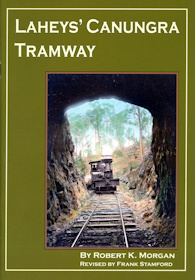 Laheys'
Canungra Tramway (Third Edition)
Laheys'
Canungra Tramway (Third Edition)
By Robert K. Morgan, revised by Frank Stamford
ISBN 0 909340 60 5
This booklet describes Queensland's largest timber tramway. It was originally published as a special edition of Light Railways, (No.54, Summer 1975-76).
When first published as a booklet in 1988 it was completely revised, with additional material, more photographs and maps, and a larger page size to give better presentation. This Third Edition has replaced some of the B&W photos with hand-tinted versions, and updated the "current situation" with 2022 photographs.
Laheys Canungra Tramway was a 3 ft 6 in gauge timber tramway in south-east Queensland which operated from about 1903 to the early 1930s. It used one B class Climax locomotive, and two A class and one B class Shay locomotives. The tramway ran through superb scenery, and included one tunnel through rock, and a 1 in 12-1/2 (8%) grade for over half a mile.To add more interest, it had a very basic T Ford railcar, an even more basic Commer railcar, and a home-made passenger car.
Soft cover, 32 pages plus 4 page card cover, A4 size, 26 photographs, 3 maps and 2 diagrams, references, and index.
A$10.00 plus postage. (Weight 230gm)
[price to LRRSA members $A7.50 plus postage]
Orders can be placed through the LRRSA Online Shop
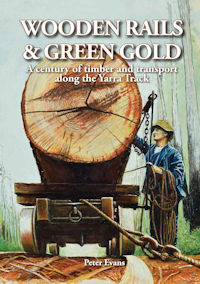 Wooden Rails & Green Gold
A century of timber and transport along the Yarra Track
By Peter Evans
ISBN 978-0-909340-59-9
The Yarra Track crossed the Great Dividing Range in Victoria, from Healesville to the gold mining town of Woods Point. The first wheeled vehicle to reach Woods Point via the Track arrived on 1 November 1864.
The first chapters of Wooden Rails & Green Gold give a detailed history of all the small townships which developed along the Track. There were many of these, including Fernshaw, Marysville, and Matlock. Detailed maps and historic photographs help to bring these places to life.
Subsequent chapters describe the development of the timber industry in the area. A large number of timber tramways were built to bring the timber from the forest to the Yarra Track. The book includes many exquisite maps. One of these shows the alternative surveys for narrow and broad-gauge extensions of the VR’s Healesville railway to Narbethong. No Narbethong railway was built due to the desire to protect the water catchment. The book explores the conflict which existed between the protectors of the water catchment and the timber and tourist industries. >p>The book is based on 35 years of patient trawling through archives and newspapers, supported by interviews with many of the sawmill residents, and intensive field research at sawmills, mine and tramway sites. It describes what went on in these forests and the difficulties faced by those who lived and worked there.
Hard cover, 288 pages on art paper, A4 size, 335 photographs, 54 maps and diagrams, glossary, bibliography, references, and index.The price is $77.00; ($57.75 to LRRSA members)
(Weight: 1,660 gm)
Orders can be placed through the LRRSA Online Shop
 Tramways, Coconuts and Phosphate
A History of the Tramways of Ocean Island and Nauru
By David Jehan
ISBN 978-0-909340-58-2
Nauru and Ocean Island are about 290 km apart and around 3000 km from Brisbane. For most of the twentieth century the major activity on both islands was phosphate mining, for the manufacture of superphosphate.
On both islands tramways were used between the mines and the jetties. Over 25 steam locomotives of 2 ft and 3 ft gauge were used, as well as two electric, five petrol, and seven diesel-hydraulic locomotives. This book describes the tramways in detail. It also explores the discovery of the phosphate, the establishment of the industry, its management, and the living and working conditions of the many people who worked there.
Soft cover, 144 pages, A4 size, 195 photographs, 16 maps, plans and diagrams, references
The price is $33.00; ($24.75 to LRRSA members)
(Weight: 735 gm)
Orders can be placed through the LRRSA Online Shop
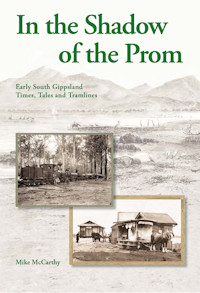 In the Shadow of the Prom
Early South Gippsland: Times, Tales and Tramlines
By Mike McCarthy
ISBN 978-0-909340-56-8
In the Shadow of the Prom is a history of the early settlement of south Gippsland from Foster to the Mullundung forest north-east of Yarram. The development of the towns and the importance of coastal shipping to their survival is comprehensively covered.
It includes extensive details and maps of numerous tramways, which provided transport from the coast before the coming of the South Gippsland Railway. The 2 ft gauge steam operated Goodwood tramway from Port Albert is covered in detail, as is the 2 ft 6 in gauge Victorian Railways Port Welshpool line. The illustrations, including photographs, maps and diagrams are some of the best to be produced so far in an LRRSA publication
Hard cover, 285 pages, A4 size, 212 photographs, 64 maps, plans and diagrams, with glossary, bibliography, references, and index
The price is $66.00; ($49.50 to LRRSA members)
(Weight: 1400 gm)
Orders can be placed through the LRRSA Online Shop
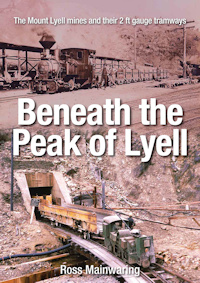 Beneath the Peak of Lyell
The Mount Lyell mines and their 2 ft gauge tramways
By Ross Mainwaring
ISBN 978-0-909340-55-1
The book is a comprehensive history of the copper mines of the Mount Lyell area around Queenstown, Tasmania; and the associated 2 ft gauge tramways.
It describes the copper mining and ore treatment processes over the life of the various mines from the beginning around 1890, and the way the extensive series of 2 ft gauge tramways were essential to the mines’ success. Motive power included horse, steam, electric, battery-electric, and internal-combustion, as well as cable haulage. It also describes the constant need to seek efficiencies to keep the mines viable as the quality of the ore steadily fell, and the world copper price see-sawed.
Hard cover, 263 pages, A4 size, 228 photographs, 35 maps, plans and diagrams, with glossary, bibliography, references, and index
The price is $66.00; ($49.50 to LRRSA members).
(Weight: 1400 gm)
Orders can be placed through the LRRSA Online Shop
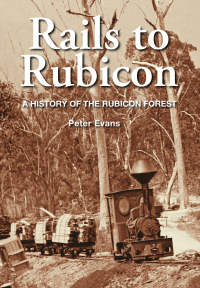 Rails to Rubicon
A History of the Rubicon Forest
By Peter Evans
ISBN 978-0-909340-54-4
This book by Peter Evans was published by the LRRSA in 1994 and has been out of print for about 15 years. A second edition is now available. It is a hard-cover book of A4 size with 200 pages and about 240 illustrations.
The book describes the 2 ft, 3 ft, and 3 ft 4½ in gauge tramways in Victoria’s Rubicon forest, and the 2 ft gauge tramway which connected the forest with Alexandra railway station. The tramways were used for the timber industry and for a hydro-electricity scheme.
Only minor changes have been made to the text, but photographic reproduction will be greatly improved, and better quality paper is being used. The maps are now in three colours with waterways in blue, and the rolling stock diagrams are now in colour. A few black and white photographs have been replaced with colour versions, and there are a couple of extra photographs.
Hard cover, 200 pages, A4 size, 240 photographs and maps, bibliography, references, and index
The price is $49.50; ($37.00 to LRRSA members).
(Weight: 1300 gm)
Orders can be placed through the LRRSA Online Shop
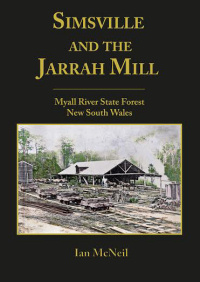 Simsville and the Jarrah Mill
Myall River State Forest, New South Wales
By Ian McNeil
ISBN 978-0-909340-52-0
The Myall River State Forest, between Buladelah and Stroud, lies about 170 km north of Sydney. With its dense hardwood tree cover – known as the Purgatory Scrub – it was very tempting to timber companies, but its rugged terrain proved a great obstacle. This book describes the efforts of a succession of five companies, to exploit the timber. It involved the establishment of a sawmill and logging tramways in the State Forest, and outlet tramways to the port of Allworth, on the Karuah River, from where the timber was taken to Sydney in shallow-draft steamers.
A village, known as Simsville, grew up around the sawmill, with up to 100 residents. The sawmill operated from 1912 to 1947 and the book records the names of over 300 people who were associated with the operation.
The author – Ian McNeil – started research on this book 30 years ago, interviewing many former employees and residents, and the book gives an insight into the social life of Simsville, as well as the working conditions. He also carried out extensive field research, and as a result the book contains detailed maps, showing the tramway routes, the bridges, earthworks, and zig-zags. The country was mountainous, and although the tramways were well engineered, they were steeply graded and sharply curved. To work them three steam locomotives, Slippery Sam, Soward, and Daddy Long Legs, were used. They were of the Climax geared type, designed to work on rough track at very low speed.
Soft cover, 96 pages, A4 size, 55 photographs, 12 maps and diagrams, references, and index
Price A$29.00 plus postage.
[price to LRRSA members A$21.75 plus postage]
(Weight: 490 gm)
Orders can be placed through the LRRSA Online Shop
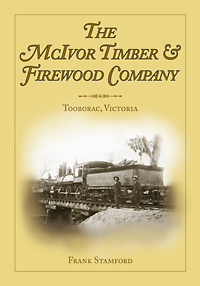 The McIvor Timber & Firewood Company
Tooborac, Victoria
By Frank Stamford
ISBN 978-0-909340-51-3
This book presents the history of the McIvor Timber & Firewood Company. The company operated from 1906 to 1927. Its main product was firewood for the Bendigo and Melbourne markets. To transport the firewood the Company built 5 ft 3 in gauge tramways from Tooborac to Mitchell's Creek, Puckapunyal, Moormbool West and Cherrington.
The tramways were operated by two Baldwin 2-6-0 locomotives, and later an ex-VR W class 4-6-0. This book records the history and routes of these tramways, and gives details of remains which were found on extensive site inspections made between 1971 and 1986. Most of this area is now occupied by the army and is not accessible.
At the time the Company operated, there were settlements at Major's Line and Moormbool West. This book gives an insight into the activities of these settlements, including social events, which the McIvor Company supported. The book includes over 103 photographs, 23 maps and diagrams, references, and index.
See the Table of Contents and Index - click here
Soft cover, 104 pages, A4 size, 103 photographs, 23 maps and diagrams, references, and index.
Price A$30.00 plus postage.
[price to LRRSA members A$22.50 plus postage]
(Weight: 485 gm)
Orders can be placed through the LRRSA Online Shop
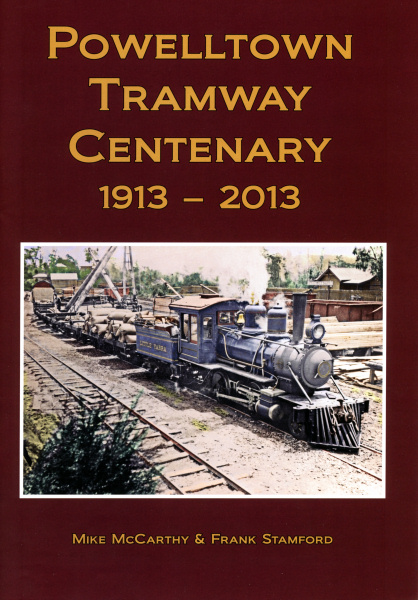 Powelltown Tramway Centenary 1913-2013
By Mike McCarthy and Frank Stamford
ISBN 978-0-909340-50-6
This publication is now out of print, however the Society has made it available as a Free Download. The book contains 44 photographs and 10 double page maps with gradient profiles. There are two versions - either single A4 pages (with all the double page spreads split over two successive pages) or as a double-page format with pairs of pages visible side-by-side.
A4 single page download (21Mb)
A4 double page download (13Mb)
This is a 32 page A4 publication to commemorate the centenary of the Powelltown Tramway, and released in conjunction with the Upper Yarra Valley Historical Society's celebrations on 17 November 2013. It was included as a members' supplement to Light Railways No.233, October 2013, and all financial members of the Society received a copy as part of their subscription.
The booklet was built around the original survey plans for the tramway, and is a stunning example of cartography. A series of double page spreads show course of the line from Yarra Junction through Powelltown and "The Bump" tunnel, and then up beyond New Ada as far as Starlings Gap.Alongside the maps are gradient profiles, and there are numerous photographs. While a number of the photos may be well known, their reproduction in this publication is excellent, better then ever seen before.
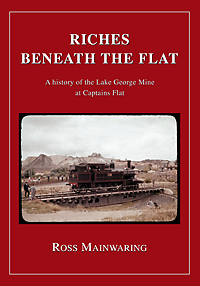 Riches beneath the Flat
A history of the Lake George Mine at Captains Flat
By Ross Mainwaring
ISBN 978-0-909340-49-0
The mining town of Captains Flat has a fascinating history that has not previously been recorded in detail. It was one of the many gold mining prospects that had a brief moment of glory in the 1880s and more substantial base metal mines were established there in the late 1880s. An injection of English capital in 1896 raised hopes of prosperity and large processing facilities and a steam operated tramway were established. Unfortunately, the processing technology of the time could not handle the silver-lead-zinc sulphide ores and the mine closed in 1899.For The development of the 'selective flotation' process during the early twentieth century, particularly at Broken Hill, brought new hope for development of the ore bodies at Captains Flat. Again English capital came to the fore and the company Lake George Mines Limited was floated in 1927 to develop the field. The onset of the Depression and negotiations over the construction of the branch railway line from Bungendore to Captains Flat delayed the start of production until 1939.
Ross Mainwaring's book covers the history of Captains Flat and its mines through to 1939 in some detail, but his primary focus is on the operation of the Lake George Mine from 1939 through to its closure in 1963. Using company records at the Noel Butlin Archives of Business & Labour at the Australian National University and extensive newspaper research, Ross has drawn together a fascinating history of the company, the men who mined and transported the ore, and the community of Captains Flat during these years.
Particular attention is given to the underground railways used to haul the broken ore from the stopes to the main vertical shaft for conveyance to the surface, but there is also extensive coverage of the transport of the ore concentrate by rail from Captains Flat to Port Kembla for export. In short, it is a thoroughly researched and well-written history that will provide readers with an enhanced understanding of the working conditions and challenges of the mine and its role in sustaining the community.
See the Table of Contents and Index - click here
|
Soft cover, 104 pages, A4 size, 62 photographs, 12 maps and diagrams, references, and index. Price A$29.70 plus postage. (Weight: 485 gm) |
Orders can be placed through the LRRSA Online Shop
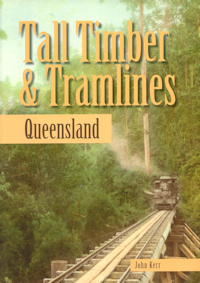 Tall Timber and Tramlines Queensland
By John Kerr
ISBN 978-0-909340-46-9
This book describes all the Queensland timber tramways known to the author when the manuscript was released for publication in 2005.For climatic and other reasons Queensland had fewer timber tramways than most other Australian states. As a result it is possible in this book of 100 pages to mention all of those known to exist when the manuscript was prepared. All were closed by the end of the 1930s.
They ranged from the engagingly primitive to the well engineered Laheys' Canungra Tramway.
The author, the late John Kerr, was well qualified to write this history. In 1998 he completed the Forest Industry Heritage Places Study, Sawmills and Tramways, South Eastern Queensland, for the Queensland Department of Environment. This was a detailed study of archaeological remains of timber industry activities in south-east Queensland.
John Kerr was a consultant statistician with the CSIRO, but became an active historian, specialising in railways, and the sugar, mining and timber industries of Queensland. He was a Fellow of the Royal Historical Society of Queensland and of the Federation of Historical Societies, a Founder of the Professional Historians Association (Queensland), and was the author of many books on Queensland history.
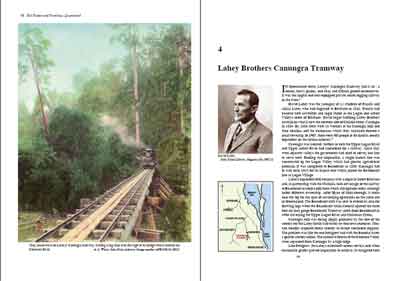
Photographs
Many of the photographs have not previously been published. They include reproductions of six superb hand-coloured photographs of Laheys’ Canungra Tramway dating from c.1912. One of these, showing a Shay locomotive crossing a bridge is reproduced as a double-page spread, two others are full page reproductions.
See the Table of Contents - click here
See the Index - click here
|
Soft cover, 104 pages, A4 size, 90 photographs, 28 maps and diagrams, references, bibliography, and index. Price A$29.95 plus postage. (Weight: 485 gm) Orders can be placed through the LRRSA Online Shop |
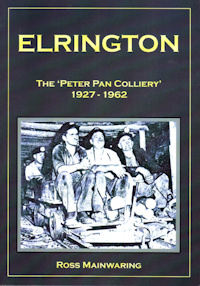 Elrington
The 'Peter Pan Colliery' 1927 - 1962
By Ross Mainwaring
ISBN 978-0-909340-47-6
Elrington is a history of a coalmine near Cessnock NSW, established by the Broken Hill Proprietary Co. Ltd in 1927 to supply coal to its Newcastle steelworks. BHP’s intention was to pioneer the use of modern coal extraction methods at Elrington.
This book describes the technology used, and the problems the company faced in introducing it. The underground 3ft 6 in gauge railways using battery locomotives are described, as well as the standard-gauge steam operated railway which served the mine.
The author also looks at the working conditions and social life of the miners and their families. For various reasons Elrington colliery never achieved its planned output of 3000 tonnes a day. Like Peter Pan, Elrington colliery never grew up.
See the Table of Contents - click here
|
Soft cover, 96 pages, A4 size, 64 photographs, 9 maps and diagrams, references, bibliography, and index. Price A$25.95 plus postage. Orders can be placed through the LRRSA Online Shop |
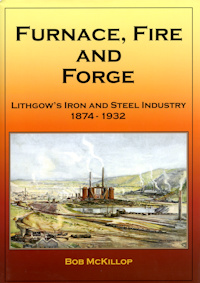 Furnace, Fire and Forge
Lithgow's Iron and Steel Industry 1874 - 1932
By Bob McKillop
ISBN 0 909340 44 7
Contributions by Ray Christison, Ian Holt, David Jackson, Jim Longworth, Bruce Macdonald, Jeff Moonie, Greg Patmore, Jerry Platt, John Prattis, Don Reynolds, Ian Rufus, Frank Stamford and Alan Watson
This book is the product of a systematic and in-depth research project. It tells the story of Australia’s first and only inland heavy industrial centre, from its beginnings with the opening of New South Wales’ Great Western Railway into the Lithgow Valley in 1869 and the establishment of the first blast furnace there in 1874, to the final closure of the iron and steel works in 1932.
Furnace, Fire and Forge provides new insights into the pioneers of Australia’s iron and steel industry and tells the story of its operations from the perspective of the men (and the handful of women) who toiled at the blast furnaces, the rolling mills, the open-hearth steel furnaces, the collieries and quarries that fed the furnaces, the railways that transported the materials and the administrative offices that supported these operations.
There are separate chapters on the mines and quarries that provided raw materials to the works; and the industrial railways that transported the materials around the site.
The concluding chapters review the lessons that have emerged from the Lithgow experience and how the community responded to the closure of its ‘life blood’.
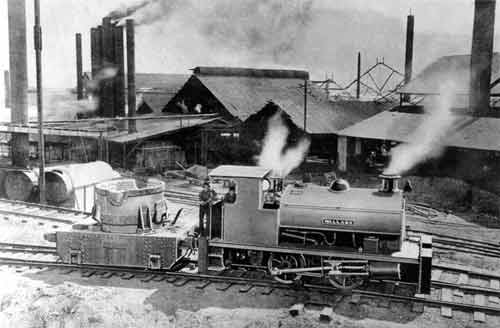
| One of the twenty locomotives used by G&C Hoskins and its predecessors at Lithgow steel works and associated plants. The works railways, and those of the limestone quarries, iron ore mines, and collieries which supplied the raw materials, are described and illustrated in the book. Hard cover, 320 pages, A4 size, over 250 photographs, maps, diagrams, references, bibliography, and index. A$59.95 plus postage. (Weight 1,650 gm) Orders can be placed through the LRRSA Online Shop |
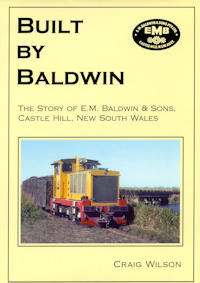 Built
by Baldwin
Built
by Baldwin
The Story of E. M. Baldwin & Sons, Castle Hill, NSW
By Craig Wilson
ISBN 0 909340 42 0
This is the history of E. M. Baldwin & Sons, the most innovative and successful builder of diesel industrial railway equipment in Australia, best known for their introduction to the Australian sugar industry of the bogie canefield locomotive.
This book is not only the story of the development of Baldwin canefield locomotives. It also describes underground, shunting, and fairground locomotives, brake wagons, and the diverse range of engineering work undertaken by the Company, from stainless steel vessels to broad-acre agricultural tractors.
From the mid 1950s Australia's sugar millers were rapidly replacing their steam locomotives with diesels, with the market split between two large companies - Clyde Engineering Co. Pty Ltd, and Commonwealth Engineering (Queensland) Pty Ltd.
The family firm of E. M. Baldwin & Sons would seem to have been a most unlikely competitor. Still reflecting its farming origins with large scale egg production, its small general engineering business specialised in custom designed stainless steel food preparation equipment.
But in 1962 the firm was approached to build a small canefield locomotive, and a year later it started its pioneering work with flame-proofed rail vehicles. Numerous diesel locomotives followed. The book includes a detailed production list of the Company's locomotives, and scale drawings of many of its locomotives.
The author has had direct access to the Company's owners, and to many of the records of the Company, so this is the definitive history of the Company, and gives much detail on the performance of individual locomotives.
Hard cover, 160 pages, A4 size, 148 photographs, and 16 diagrams, references, bibliography, and index.
A$44.00 plus postage. (Weight approx. 950 gm)
[price to LRRSA members $A33.00, plus postage]
Orders can be placed through the LRRSA Online Shop
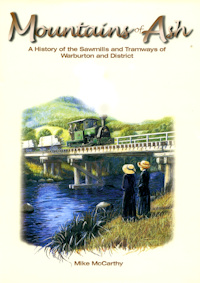 Mountains
of Ash
Mountains
of Ash
A History of the Sawmills & Tramways of Warburton and District
By Mike McCarthy
ISBN 0 909340 41 2
Sixty-six kilometres east of Melbourne, and nestled deep in a valley below towering timbered slopes, for over a century Warburton has been a popular weekend destination for those attracted by its natural beauty and tranquility.
During the period prior to the First World War it was the centre of Victoria's biggest sawmilling district.
It saw the establishment of 66 major sawmills and many smaller mills in the bush surrounding the town. They were linked to the railway at Warburton, Millgrove, and Wesburn through a complex system of wooden and steel-railed tramways. In total over 320 km of tramways could be found in the bush surrounding Warburton. Horses, locomotives, and rail tractors hauled the timber, and the tramways included many spectacular bridges, cable-worked haulages, sharp curves and steep grades.
The tramways provided picturesque walking tracks for holiday makers, and attracted many first class photographers.
This book includes 320 photographs. Almost all of these have not been published before.
Fifty-two of the photographs are printed as duo-tones, a special process which increases the tonal range of the photograph.
Fourteen of the maps are printed in four colours, whilst most maps and diagrams are printed in two or three colours.
Hard cover, 312 pages, A4 size, 280 photographs, 50 maps, various diagrams, references, bibliography, and index.
A$59.95 plus postage. (Weight 1,500 gm)
[price to LRRSA members $A44.96 plus postage]
Orders can be placed through the LRRSA Online Shop
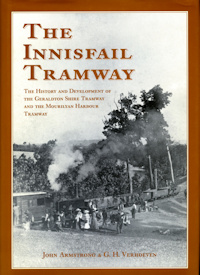 The
Innisfail Tramway
The
Innisfail Tramway
The History and Development of the Geraldton Shire Tramway and the Mourilyan Harbour Tramway
By John Armstrong & G. H. Verhoeven
ISBN 0 909340 38 2 (hard cover)
Innisfail is 80 km south of Cairns, and the largest community between there and Townsville. It is an extremely scenic area situated in the lush coastal belt of tropical North Queensland in one of the wettest parts of Australia. The 2 ft gauge Innisfail Tramway played a major role in the colourful history of the town.
Built one hundred years ago by the Geraldton Shire Council, it was subsequently taken over and operated by the Queensland Railways until they sold it to local sugar mills in 1977. The tramway carried thousands of passengers including shoppers to and from town, wharf labourers to work, racegoers to and from the course, and picnickers on pleasure trips. It carried vast quantities of bananas, timber, coal, agriculture, meat and parcels.
There were 13 steam locomotives, 13 passenger cars, four vans, and about 250 goods vehicles. Over the years the role of the tramway changed, and today the surviving parts of it are operated exclusively as privately owned sugar carrying lines. The authors have interviewed local residents and former members of the tramway staff as well as searched through official documents and newspaper reports, to produce a book which is both historically accurate, and brings to life a vanished era.
The Innisfail Tramway was first published by the Australian Railway Historical Society Queensland Division in 1973.
This new edition published by the LRRSA is completely revised, updated, and produced in the style of LRRSA books. It contains much additional material in text, photographs, maps and diagrams.
Hard cover, 128 pages, A4 size, 99 photographs (12 in colour), 8 maps and 14 rolling stock diagrams, with dust jacket.
$A37.90 plus postage. (Weight 850 gm)
[price to LRRSA members $A28.43 plus postage]
Soft cover, 128 pages, A4 size, 99 photographs (12 in colour), 8 maps and 14 rolling stock diagrams, with dust jacket.
A$29.95 plus postage. (Weight 550 gm)
[price to LRRSA members $A22.46 plus postage]
Orders can be placed through the LRRSA Online Shop in Soft Cover or Hard Cover
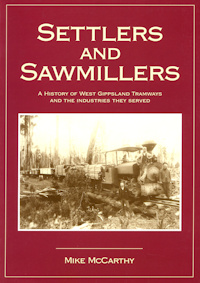 Settlers
and Sawmillers,
Settlers
and Sawmillers,
A History of West Gippsland Tramways and the Industries they Served 1875-1934
by Mike McCarthy
ISBN 0 909340 37 4
With the opening of the Gippsland railway to Sale, Victoria, in 1879 the dense forest in West Gippsland provided a valuable resource, which sawmillers were quick to exploit. There was an intense burst of timber production as farmers, seeking to clear their land, worked in partnership with sawmillers, to take advantage of a burgeoning demand for timber in Melbourne. In time the process saw the clearing of West Gippsland to the state that we now know it, and the growth of dairy farms across what had previously been densely forested hills. Between 1875 and 1900 at least 130 sawmill sites were worked in this area, between Beaconsfield and Trafalgar. They were connected to the main towns and railway by tramways using mostly wooden rails. This network of trams, and their associated industries, provides the underlying framework of this book, which explores the relationship between the settlers and the sawmillers, which was so important in establishing agriculture in Gippsland.
Settlers and Sawmillers is a soft-cover reprint of the book first published in 1993.
Soft cover, 168 pages, A4 size, 96 photographs - mostly nineteenth century gems, 17 maps and diagrams - including seven in two colours, 6 graphs, one locomotive diagram, and 37 cameo images from the turn of the century.
A$31.90 plus postage. (Weight 700 gm)
[price to LRRSA members $A23.93 plus postage]
Orders can be placed through the LRRSA Online Shop
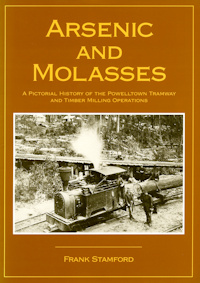 Arsenic
and Molasses
Arsenic
and Molasses
A Pictorial History of the Powelltown Tramway and Timber Milling Operations
by Frank Stamford
ISBN 0 909340 34 X (Soft cover edition)
ISBN 0 909340 35 8 (Hard cover edition)
When the railway from Lilydale to Warburton was opened in 1901 it led to the rapid development of the timber industry in that area. Until 1912 this was in the hands of small operators. In that year a large company with major shareholders in Western Australia and New Zealand was formed to exploit the newly developed Powell process of timber preservation.
The process involved the heating of timber in a solution containing molasses, water, and other ingredients, including arsenic to control white ants. To use the process economically involved the building of a large sawmill and a company town. The Company chose a site 10 miles from Yarra Junction, and named it Powelltown. To provide transport the Company built narrow-gauge steam operated tramways through the bush. The Powell process proved a failure, but the timber milling operations centred on Powelltown remained. This book provides an illustrated history of those operations, and an insight into a way of life long since gone.
Arsenic and Molasses is a companion volume to the LRRSA book Powelltown.
It is designed in the same style, but its emphasis is on photographs, with
brief text to introduce each of the eleven chapters, and to explain the
illustrations. It is intended to complement Powelltown.
All the photographs are different to those published in Powelltown.
Many of the photographs are full page windows-to-the-past, from photographers such as John Buckland, Rev. Brenton, Fred Rayment and others.
Hard cover, 88 pages, A4 size, 103 photographs, 7 maps and diagrams,
with dust jacket and end papers. The end papers consist of two different
A3 size photographs depicting Coffee Pot at work in the bush eighty
years ago.
Print run limited to 1,000 and will not be reprinted.
$A36.00 plus postage. (Weight 650 gm)
[price to LRRSA members $A27.00 plus postage]
Soft cover, 88 pages, A4 size, 103 photographs, 7 maps and diagrams.
A$24.00 plus postage. (Weight 470 gm)
[price to LRRSA members $A18.00 plus postage]
Orders can be placed through the LRRSA Online Shop in Soft Cover or Hard Cover
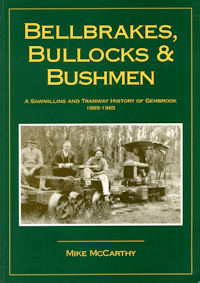 Bellbrakes,
Bullocks & Bushmen,
Bellbrakes,
Bullocks & Bushmen,
A Sawmilling and Tramway History of Gembrook 1885-1985
by Mike McCarthy
ISBN 0 909340 33 1
Following the opening of the 2 ft 6 in gauge railway to Gembrook (64 km east of Melbourne) in 1900 timber milling became an important industry in the forest to the east of Gembrook. At least sixty sawmill sites were worked in the region, and for some time sawmilling was the largest single employer in the area. Together they produced a huge volume of timber, not only to satisfy the needs of metropolitan Melbourne, but also to provide fruit cases for the district's orchard industry.
A fascinating network of tramways, providing the vital transport link to the railhead, fanned to the east and north of the town. The construction and operation of these lines is covered in detail but it is integrated with the history of the mills that led to their existence, and the people that worked in the industry or lived in the bush at the mills.
Bellbrakes, Bullocks and Bushmen is a reprint of the book first published in 1987, which has been out of print for many years.
Soft cover, 104 pages, A4 size, 71 photographs, 17 maps and diagrams.
A$26.00 plus postage. (Weight 500 gm)
[price to LRRSA members $A19.50 plus postage]
Orders can be placed through the LRRSA Online Shop
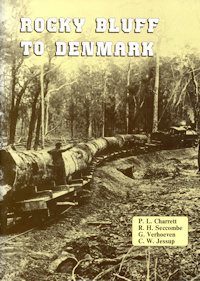 Rocky Bluff to Denmark
by Peter Charrett, Roger Seccombe, Gerry Verhoever and Bill
Jessup.
Edited by Frank Stamford
This publication contains a selection of reprints of four outstanding articles from past issues of Light Railways, and marks the twenty-fifth anniversary of LRRSA. In subject matter they span the continent of Australia, from northern Queensland to southwest Western Australia. Additional photographs, maps redrawn by Geoff Thorpe, and a thoughtful foreword by Norm Wadeson help set this book above the original articles.
Peter Charrett describes the role of the several light railway systems used in the construction of the Hume Reservoir on the Murray River near Albury; Roger Seccombe takes the reader to opposite ends of the scale in magnitude, longevity and success of light railway operations: the Elphinstone Timber Tramway, which operated from the VR station at Elphinstone in Central Victoria; Gerry Verhoeven presents the results of research and extensive trekking along the 40 or so miles of formation of 2ft gauge lines which once connected tin mines at Stannary Hills, Rocky Bluff and Irvinebank with the government railway at Boonmoo, Far North Queensland; Bill Jessup offers a history of the Millar brothers' timber milling and tramway operations in the Karri and Jarrah forests around Denmark and Torbay in Western Australia.
Rocky Bluff to Denmark was published in 1986, and is long out of print. Each of the articles have been made available as free downloads.
66 pages, numerous photographs, maps and diagrams.
Hume Reservoir Construction (11Mb)
Elphinstone Timber Tramway (12Mb)